

Why Mushrooms Are the Future of Protein
The global alternative protein market is worth over $40 billion today and growing fast. Amid plant-based meat, lab-grown chicken, and cricket flour, one source is quietly outpacing all of them in scientific credibility, sustainability, and real-world nutrition: the fungal kingdom.
01 · The contextThe Protein Problem the World Is Trying to Solve
Before we get to mushrooms, it helps to understand what the food industry is racing to fix.
The United Nations projects global population will reach 9.8 billion by 2050. Feeding that population at current protein consumption levels — primarily through conventional livestock farming — is environmentally impossible. Animal agriculture already accounts for roughly two thirds of agricultural greenhouse gas emissions and occupies three quarters of the world's agricultural land, while delivering protein to only a fraction of the global population efficiently.
The response has been a wave of alternative protein investment: Beyond Meat, Impossible Foods, precision fermentation, insect protein, and cultivated meat have all attracted billions in venture capital. The global alternative protein market, valued at over $100 billion in 2025, is projected to grow at a CAGR of 18.5% toward $590 billion by 2035. But most of these alternatives come with serious trade-offs — in taste, cost, processing complexity, or consumer acceptance.
Fungi-based protein addresses most of these trade-offs simultaneously. Here's why.
What Makes Mushroom Protein Biologically Unique
Not all protein is equal. The molecular profile of fungal protein sets it apart from every plant-based alternative.
A complete amino acid profile
Most plant proteins are "incomplete" — they lack one or more of the nine essential amino acids the human body cannot synthesise on its own. Soy is the notable exception, but it carries hormonal concerns for some consumers. Edible mushrooms have a protein concentration of approximately 8.5–36.9% dry weight, and critically, their amino acid profile includes all nine essential amino acids — making them one of the only complete non-animal proteins in nature.
Mycelium as a protein delivery system
Mycelium — the root network of fungi — produces protein through a process fundamentally different from photosynthesis. It breaks down organic matter and converts it into high-density nutrients, including proteins, beta-glucans, and bioactive compounds. This means mycelium can be cultivated on agricultural by-products, requiring no arable land, minimal water, and growing in days rather than months.
Superior bioavailability vs. plant isolates
One underreported issue with protein powders and bars is that protein content on the label doesn't equal protein your body actually absorbs. Fungal protein has a cellular structure that breaks down efficiently in the human digestive system — without the anti-nutritional factors (phytates, trypsin inhibitors) found in legumes and grains that reduce bioavailability. What you eat is close to what you absorb.
Standard plant protein bars typically use isolated pea or soy protein — highly processed extracts stripped of their original nutritional context. FungoFit bars deliver protein alongside beta-glucans, adaptogenic compounds, and bioactive molecules that exist naturally in the mycelium matrix. That's whole-food nutrition, not a processed isolate.
Three Areas Where Fungi Outperform the Competition
Compared head-to-head against every major alternative protein category, fungi hold a meaningful edge in three dimensions.
Sustainability
Mycelium grows on agricultural waste substrates — sawdust, straw, spent grain — with no need for arable land, pesticides, or significant water use. Carbon footprint per gram of protein is a fraction of both animal and most plant sources.
Nutritional density
Unlike isolated plant proteins, mycelium delivers protein alongside beta-glucans, B vitamins, mineral cofactors, and adaptogenic compounds — none of which survive the extraction process used to make pea or soy isolates.
Minimal processing
54% of consumers are concerned about ultra-processed foods in their diets. Functional mushroom ingredients require no chemical extraction, no hexane solvents, no artificial binders. Mycelium is dried, milled, and used — whole.

How Fungi Stack Up Against Other Alternative Proteins
A clear-eyed look at the full landscape of alternative protein, evaluated on what actually matters to consumers in 2025.
| Source | Complete protein? | Processing level | Environmental footprint | Bioactive compounds |
|---|---|---|---|---|
| Fungi / Mycelium | Yes | Minimal | Very low | High |
| Pea protein | Partial | Moderate | Low | None (isolated) |
| Soy protein | Yes | High | Moderate | None (isolated) |
| Cultivated meat | Yes | Very high | Moderate (debated) | None |
| Insect protein | Yes | Moderate | Low | Some |
| Whey protein | Yes | High | High | None (isolated) |
Consumers Are Already Moving This Direction
The data from 2025 surveys confirms that mushrooms are breaking into mainstream consumer interest — not just niche wellness circles.
A 2025 consumer survey found that mushrooms ranked third among desired new plant-based protein ingredients, cited by 25% of respondents — behind only lentils and chickpeas, both of which have been mainstream for decades. For a category as new as functional mushroom nutrition, that level of unprompted consumer interest is remarkable.
The UK alternative protein market alone is expected to grow from $1.4 billion in 2025 to $6.2 billion by 2035, driven by strong government alignment with net-zero food production targets and widespread supermarket access. Fungi-based proteins are well-positioned to capture a disproportionate share of that growth precisely because they satisfy the twin demands consumers now rank highest: health credentials and minimal processing.
The protein transition is not a future event — it's happening now. The brands that establish credibility in functional mushroom nutrition today are building a category position that will become exponentially harder to enter as the market matures. First-mover advantage in a growing category is worth more than market share in a mature one.
FungoFit is one of the first brands in the UK to bring functional mycelium protein to the everyday snack format. That's not a product claim — it's a market timing observation.
The FungoFit Range
Three bars. Three functional mushrooms. One mission: make fungi-based nutrition genuinely accessible.
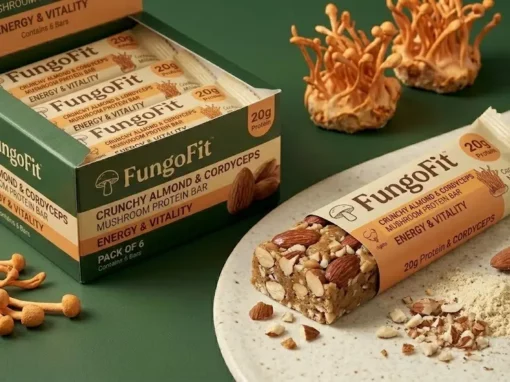
Crunchy Almond & Cordyceps
Clean cellular energy from Cordyceps mycelium. No jitters, no crash.
Shop Now →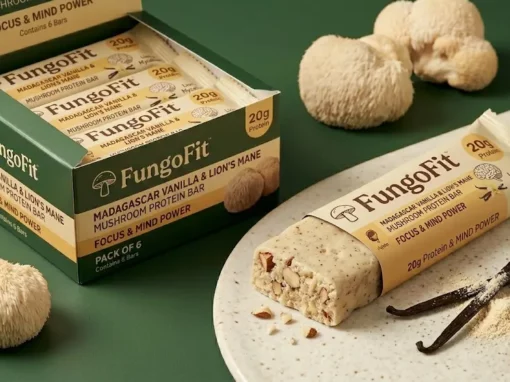
Madagascar Vanilla & Lion's Mane
NGF-stimulating compounds for sustained mental clarity and focus.
Shop Now →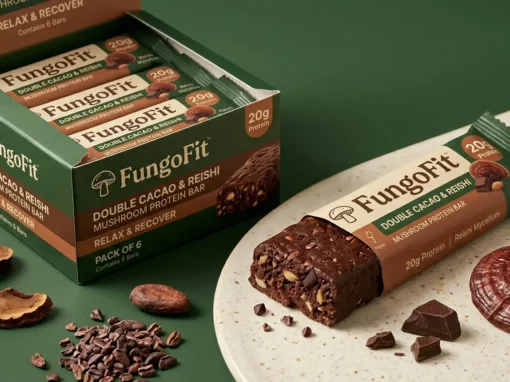
Double Cacao & Reishi
Adaptogenic stress modulation and immune support from Reishi mycelium.
Shop Now →The Convergence Is Already Happening
The future of protein isn't one thing — it's a portfolio of sources that each solve a different piece of the sustainability, health, and scalability puzzle. But among all the candidates, fungi occupy a uniquely advantageous position: complete amino acid profile, minimal processing, negligible environmental footprint, and a bioactive compound matrix that no other protein source can match.
The market data, the consumer surveys, and the science are all pointing in the same direction. Mushrooms are not a trend. They're a category — and it's still early.
Real food. Fungal power.